
Healthy Diet
Good nutrition is important to make sure children:
- get the right amount of nutrients they need while they are growing rapidly
- don’t consume too much food, which may lead them to become overweight or obese
The Eatwell Guide uses government advice to show what a healthy and balanced diet looks like. It shows what a balance of foods should look like in one day or over a whole week.
The advice in the Eatwell Guide applies to children from the age of 2 years.
Make sure that food is prepared appropriately to minimise any risk of choking. The Food Standards Agency has two posters on how to prepare food safely to avoid choking.
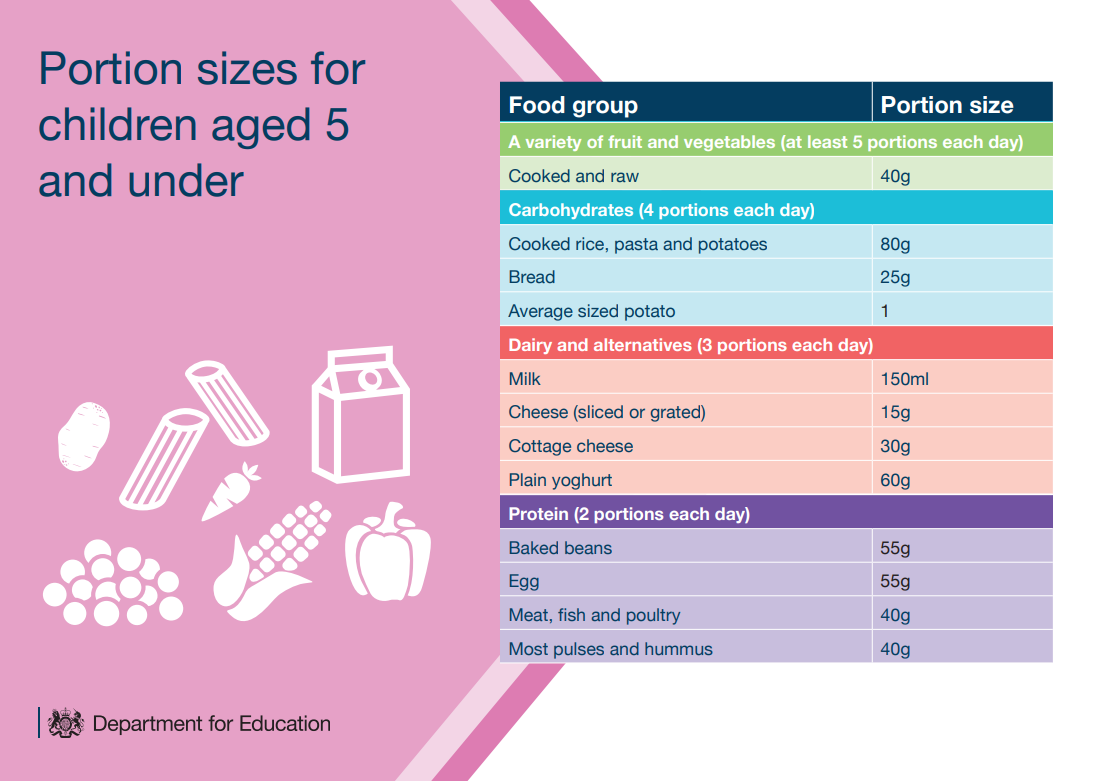
Portion size for children aged 1 to 5 years
Planning food activities with children
Cooking is a great experience for young children and helps to create a positive relationship with food.
The benefits of food activities
There are lots of benefits of providing fun food activities for children:
- confidence – children are more likely to try new foods and widen their diet
- language – children learn new vocabulary and words from different languages
- physical – cooking helps children practice physical skills, such as gross and fine motor skills, which help muscle development and hand-eye coordination
- emotional – children can feel competent and proud of themselves when cooking
- relationships – cooking activities can support team work and relationships between children and adults
- mathematics – children will learn numbers through counting and measuring
- science – children can observe how different ingredients mix together and the effects of heat and cooling
- understanding the world around them – including where spices come from, how vegetables are grown and sustainability
- diversity and culture – children can learn where foods come from and how different cultures use different cooking techniques
Quick and easy ideas
You can:
- make bread
- discover exotic fruit
- explore your local market
- grow herbs or vegetables indoors or outdoors
For lot’s of healthy and cost effective recipes please see the link below:
Help for early years providers : Cost-effective healthy food
Sensory food education
Oral Health
Oral health is important, even with baby teeth. This is because children’s baby teeth:
- help them to bite and chew
- support speech and language development
- help them feel confident when they smile
- make space for and help to guide adult teeth
Good oral health also keeps children free from toothache, infection and swollen gums.
Tooth decay
Children need to form good oral health habits from an early age to help avoid tooth decay. Tooth decay happens when sugars from food and drinks interact with bacteria in tooth plaque. This results in acid production, causing holes in teeth known as cavities.
If children have tooth decay, they may have yellow, brown or black marks on their teeth. They may also complain about their teeth hurting, particularly when eating or drinking.
Tooth decay is largely preventable, but it’s still a serious problem among young children. The Office for Health Improvement and Disparities oral health survey of 5 year old children 2024 and Public Health England oral health survey of 3 year old children 2020 found that:
- more than a fifth of 5 year olds in England have tooth decay, affecting 3 to 4 teeth on average
- children from more deprived backgrounds are more likely to have tooth decay
- 11% of 3 year olds in England have visible tooth decay, affecting 3 teeth on average
Tooth decay was the most common reason for children aged between 5 to 9 years to be admitted to hospital.
Looking after the oral health of children
There are several key steps practitioners, parents and carers can take to promote good oral health in children.
Cutting down on free sugars
You should limit the amount of free sugars children eat or drink in your setting, as well as how often they consume them. This can help to avoid tooth decay.
Free sugars include all sugar added to food and drinks by the manufacturer, cook or consumer. They are found in foods like:
- cakes, biscuits and chocolates
- processed foods – like some jarred sauces, jams and breakfast cereals
- some flavoured yoghurts
They are also found in natural products like:
- honey and syrups
- fruit juices and purees
- smoothies
Free sugars are not found in:
- whole fruit and vegetables
- plain, unflavoured milk and yoghurt
- water
Water and milk are the only safe drinks to give children in regard to their oral health. Fruit juices and smoothies should not form part of a young child’s daily diet.
As well as limiting the amount of free sugars children eat or drink, you should also make sure that they only have food or drinks that contain sugar at mealtimes. This is because, the more often their teeth come into contact with sugar, the more likely they will be to get tooth decay. Children should avoid food and drinks containing free sugars before bedtime and overnight.
Drinking bottles and cups
What children drink from can impact their oral health.
You should only give babies bottles of breast milk, formula milk, or boiled water that has cooled down.
From 6 months old, you can offer babies drinks in open-top cups. These are cups with no lids, which spill if knocked over. These cups can help children develop their sipping skills. This strengthens their face muscles, which helps them to bite, chew and talk.
When introducing open-top cups, start with smaller cups or those with handles. These are easier for babies to grip. Offer a small amount of water at first, and gradually increase this over time.
You may need to show babies how to use the cup and help them to hold it at first. Some babies may need to use a sipping cup or beaker with a spout before they can use an open-top cup. If this is the case, you should make sure that the spout does not have a valve, that drinks can freely flow through it, and that babies do not need to suck.
From 12 months old onwards, you should encourage children to have all drinks in open-top cups. From this point, avoid using any bottles or cups that need children to suck, like those with soft teats or valves.
You can find an NHS video about how and when to move babies from bottles to cups in the useful resources section at the end of this article.
Brushing teeth
As soon as a child’s teeth start to come through, they are ready for toothbrushing to start.
One of the skills children should practice before starting school is brushing their teeth with fluoride toothpaste twice a day.
For effective tooth brushing:
- use a fluoride toothpaste that contains at least 1000 parts per million (ppm) of fluoride – you can find this information on the packaging
- use a smear of toothpaste for children under 3, and a pea sized amount for those aged 3 to 6
- brush in circles for around 2 minutes, making sure to cover the whole of each tooth
- brush twice a day, including once just before bed – this allows the fluoride to keep working while children sleep
- children should spit, not rinse, after brushing – this avoids washing away the fluoride
- adults should help children to brush their teeth until they are 7 years old to make sure they are brushing properly
Local NHS dentists can be found on the NHS website.
If the child needs urgent dental care, and their dentist does not offer emergency appointments, parents and carers can contact NHS 111.
Useful resources
The British Society of Paediatric Dentistry have created a series of oral health videos for children, in partnership with Dr Ranj, Hey Duggee and CBeebies.
CBeebies’ My First shows Ava’s first visit to the dentist and has lots of good information about taking care of your teeth.
The British Society of Paediatric Dentistry provides information to share with parents in a number of different languages.
This NHS video on baby bottles and cups explains when to move babies from bottles to cups and why.
This video by Prof. Zoe Marshman explores how early years educators can improve children’s dental health.
The NHS page on looking after your baby’s teeth explains how to brush and care for babies’ and young children’s teeth.
This BBC article explains key strategies for showing a toddler how to brush their teeth.
This healthy teeth video from HENRY looks at what we can do to help children grow up with healthy teeth.
Dr Milad Shadrooh, known as The Singing Dentist, shares advice and answers to common questions about taking care of children’s teeth.
PACEY’s oral health advice includes fact sheets for parents, and their nutrition advice encourages healthy eating habits.
Toilet Training
When to start toilet training
Every child’s development is unique. Some children can be toilet trained earlier and faster than others. It is important to support children to learn at their own pace.
The advice on when to start toilet training children can vary. NHS guidance explains that most children are ready to begin toilet training from around 18 months to 2 years. However, some people may choose to start earlier.
Starting toilet training after 2 and a half to 3 years can make it harder for some children to learn this new skill.
Different cultures may start toilet training at different ages. Toilet training should be guided by the child’s parents or carers. It is important to respect parental preferences during the process.
How to toilet train
The NHS provides advice on how to potty train.
Their 3 step ‘Let’s Go Potty’ approach is broken down into stages:
- Preparation
- Practice
- Stop using nappies
Toilet training challenges
It is not uncommon for children who are toilet trained and reliably clean and dry at home, to start having accidents when they begin at an early years setting.
To support your child you can:
- follow the advice the NHS provide on common toilet training problems
- review the information ERIC has on potential solutions for toilet training problems
Support children with Special Educational Needs and Disabilities (SEND)
Almost all children can learn to be clean and dry, including children with SEND. Some children may find toilet training more difficult. These children need extra time and effort with toilet training.
If children keep wearing nappies after they are ready for toilet training, it might be harder for them to get used to using the toilet in a new place.
Review the information and advice from:
- Contact on toilet training for families with children living with a disability
- ERIC on toilet training children with additional needs